Although we may try to self-assess how we are doing at work, it is the manager's role to provide clear, unbiased and constructive feedback to employees in order for them to fully understand their strengths and improve upon their challenges.
But, days get busy. Meeting space becomes unavailable. Priorities continue to change. Despite these roadblocks, managers MUST find time to conduct effective performance reviews. Keyword here is effective.
We know that managers of all experience levels may need guidance for providing such meetings. Our online, self-paced course will help managers deal with Performance Challenges and other staff issues.
Showing posts with label conflict management. Show all posts
Showing posts with label conflict management. Show all posts
Friday, March 02, 2012


Friday, December 30, 2011
Corexcel's Top 5 Blog Posts of 2011!
In case you missed it, here are our top 5 blog posts of 2011!
Check out our blog: www.trainingprofiles.com to catch up on ALL of our previous blog posts.
Here's to another year of professional training, employee assessments & continuing education!
Who's Afraid of the Big, Bad Boss?
Have you ever heard of the saying, "You don't quit your job; you quit your boss"? It's certainly true. Bad management can cause employees to feel under-appreciated, frustrated and stressed out, leaving them uninterested in their work and looking for a way out. Our 2-part blog series provides tips on improving your management skills & how to deal with a bad manager! Continue Reading...
***
DiSC Profiles Minimize Conflict & Maximize Productivity
This blog series paints the picture of a dysfunctional group and a frustrated manager who is at his wits-end. Each of our blog posts highlights the DiSC styles in order to help you relate more effectively to the D, i, S and C's in your group. Continue Reading...
***
The Training Matchmaker
When planning training for a group, take the time to define what you want your learners to know or to do when they have completed the training, keeping your budget in mind. This will help you choose the most effective type of training for your learners and for the organization as a whole. This post will help get you started on choosing the right type of training for you, your staff and your budget! Continue Reading...
***
"Be honest with me!" - The Importance of Evaluation & Feedback
We're constantly faced with the question, "How did I do?" Many poor managers are often afraid to address employees' weaknesses and provide false praise while others can be overly critical and fail to recognize the positive aspects of an employee's performance. Learn more about the consequences of providing inaccurate or no feedback and how to provide effective performance reviews. Continue Reading...
***
STOP! Ask Yourself These 6 Questions Before Choosing an Assessment
Before you select an assessment for your upcoming training program, make sure you assess the needs of your organization, your employees and your budget. Answering these questions will give you more direction so you can choose the best assessment for your group, AND get the most out of your budget! Continue Reading...
Monday, August 08, 2011
Meet Marsha: Conflict Resolution and the i Style
Marsha had a difficult time hiding her feelings from the rest of the group during her recent confrontation with Pete and Jeffrey.
Marsha was excited to share her ideas with the rest of her team but became frustrated when she felt Pete and Jeffrey were too critical. Marsha felt like her creativity was being questioned by their negative comments. Her enthusiasm turned to frustration and she defended her ideas strongly. Jeffrey’s name calling felt personal and Marsha left the conference room in tears.
The i Style: At a Glance
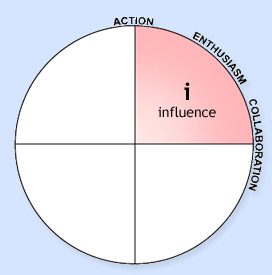
i Stands for influence
Positives:
- Outgoing
- Enthusiastic
- Optimistic
- Encourages Collaboration
- Impulsiveness
- Disorganization
- Lack of follow-through
Happy are those who dream dreams and are ready to pay the price to make them come true. - Leon J. Suenes
How does Marsha handle conflict?
Marsha, like Jeffrey, handles conflict head on. Because Marsha and other “i styles” are naturally fast-paced, they are enthusiastic and passionate during discussions and may monopolize the conversation. The i personality is known for being open with their feelings but can become overly expressive and emotional during arguments. They can also become flustered and disorganized if they feel they are being bombarded.
How does this affect other styles?
The emotion that “i styles” bring to the table can make their colleagues feel very uncomfortable. Marsha and other high i’s are often seen as overly emotional or dramatic. Their colleagues may view them as high maintenance and try to avoid confrontations with them altogether.
What can Marsha do to improve?
Those with an i personality bring creativity, enthusiasm and positive energy to any team but need to be able to accept criticism in order to take their ideas to the next level. Marsha should first and foremost slow down during arguments and really focus in on what her colleagues are saying. High i’s can be much more effective if they remain objective during discussions and eliminate the emotional influence.
This and the rest of these blogs have been developed using the Everything DiSC® Workplace profiles, group reports and facilitator’s kit.
Join us for our next blog post in which we dive into the “S” style and how they handle conflict with others.
Tuesday, August 02, 2011
Meet Jeffrey: Conflict Resolution & the DiSC Style
If you read our last blog post, DiSC Profiles Minimize Conflict and Maximize Productivity, then you can recall the story of Steve and his sales team.
Jeffrey and Marsha were yelling at each other during a discussion that originally surrounded one of Marsha’s ideas. Jeffrey grew frustrated when Marsha felt attacked by Jeffrey and became emotional. From there, Jeffrey lost focus of their original discussion, and began targeting Marsha’s personality, at one point calling her, “over emotional.”
The D Style: At a Glance

D stands for Dominance
Positives:
- Fast-paced
- Strong-willed
- Results-oriented
- Confident
Negatives:
- Impatient
- Under-developed people skills
- Insensitive
Quote
Effective leadership is not about making speeches or being liked; leadership is defined by results not attributes. – Peter Drucker
How does Jeffrey handle conflict?
Jeffrey handles conflict head on. Since those of a “D style” are fast-paced, you may find they interrupt others. They value honesty, but may lack tact in their delivery. If they feel as though they are not being heard, they can become argumentative orbelligerent. If they are having a discussion with a slower-paced individual, the D style can become impatient and frustrated.
How does this affect other styles?
Other styles may view the D style as demanding and difficult to work with. Other team members may stop speaking up in order to avoid conflict. Some members may become stressed out, overwhelmed and decide to leave the department or company.
What can Jeffrey do to improve?
While Jeffrey may have insightful things to say, he must realize that people may not listen, simply because of his tone. In order to effectively resolve conflicts with others, high D’s should practice patience and learn to effectively listen to what others are saying. They should express empathy and consider other people’s feelings before speaking. Since Jeffrey certainly has the determination to succeed, developing hispeople skills will make him more approachable and, thus more valuable to the team.
This and the rest of these blogs have been developed using the Everything DiSC® Workplace profiles, group reports and facilitator’ kit.
Join us for our next blog post in which we dive into the “i” style and how they handle conflict with others.
Friday, July 22, 2011
DiSC Profiles Minimize Conflict and Maximize Productivity
SCENE
It’s a busy Wednesday afternoon at ABC Technology, Inc. a mid-sized software and IT company based in Philadelphia, PA. STEVE, a quiet, yet successful Sales Manager, is walking down a long hallway to the coffee station when he overhears a shouting match going on between two of his employees. He finds them and the rest of his sales team in a nearby conference room.
It’s a busy Wednesday afternoon at ABC Technology, Inc. a mid-sized software and IT company based in Philadelphia, PA. STEVE, a quiet, yet successful Sales Manager, is walking down a long hallway to the coffee station when he overhears a shouting match going on between two of his employees. He finds them and the rest of his sales team in a nearby conference room.
STEVE
(Entering the conference room)
Woah! What’s going on here? What are you guys fighting about? I could hear you from down the hall.
JEFFREY
(Walking over to STEVE)
(Walking over to STEVE)
We were originally discussing an idea that Marsha had come up with, but she became irrational when we pointed out the flaws in her plan.
MARSHA
(Quickly standing up and point at JEFFREY.)
(Quickly standing up and point at JEFFREY.)
I did not get irrational! That’s just like you, Jeff. You cut me off when I’m speaking, and don’t expect me to continue with my thought. I hadn’t even gotten halfway...
Monday, June 01, 2009
One Company Gets DiSC®
This is the final article in a four-part series covering the concepts, applications and history behind DiSC®. It's one thing to take the profile and learn about behavioral styles but it's surely another to understand how to put DiSC to work for your organization. This series of articles will help you understand the theory behind the DiSC model while also providing insight into the sales, management and workplace applications.
One Company Gets DiSC
By 1978, Marston’s book had been on the marketplace for 50 years but there was no easy way to make his words on paper work as a tool to change businesses. Myers Briggs Type Indicator (MBTI) was a household name, being tossed around board rooms and conference rooms as “must have” training, but implementing MBTI practically requires a degree. By this time, different industrial psychologists had worked with both concepts and tried to build different kinds of tools using Marston’s theory and Jung’s archetypes without much success. John Geier, PhD was the first to successfully operationalize the DiSC model in the form commercialized by Inscape Publishing. Inscape Publishing offers the original DiSC© instrument, says Barry Davis. “Marston didn’t propose measuring it; he just proposed that the world consisted of these four psychological types and that we could make meaning of them and understand people better if we understand these generalized notions about how people function.” “Our original tool was called just the DiSC Personal Profile System. Then we created the DiSC Personal Profile Software, which was an electronic way to do DiSC. Recently, Inscape Publishing changed the way it packaged its DiSC systems, literally. “We used to sell assessments. Four years ago, Inscape Publishing took everything it had learned about DiSC and organized it into a system called DiSC Facilitation System,” explains Barry Davis, Vice President of Product Development and Marketing at Inscape Publishing. Introduced in early 2008, this product and approach mark yet another step forward in helping Training and Human Resource Managers successfully use DiSC in their companies. “We have really moved from just selling assessments, to selling all of the tools that are useful in applying DiSC to a specific organization or training need. That is really a big change,” says Davis. “We still have PhDs on our staff, psychologists, who develop the assessment and measuring part and the reports but we also have instructional designers, writers, video creatives, editors, web developers and marketing researchers. We have all of the functions under this roof.”
Read Full Article
Full Series of Articles
The Concept Behind DiSC: You do the Math
Digging into DiSC History
Putting DiSC Management to Work
One Company Gets DiSC
One Company Gets DiSC
By 1978, Marston’s book had been on the marketplace for 50 years but there was no easy way to make his words on paper work as a tool to change businesses. Myers Briggs Type Indicator (MBTI) was a household name, being tossed around board rooms and conference rooms as “must have” training, but implementing MBTI practically requires a degree. By this time, different industrial psychologists had worked with both concepts and tried to build different kinds of tools using Marston’s theory and Jung’s archetypes without much success. John Geier, PhD was the first to successfully operationalize the DiSC model in the form commercialized by Inscape Publishing. Inscape Publishing offers the original DiSC© instrument, says Barry Davis. “Marston didn’t propose measuring it; he just proposed that the world consisted of these four psychological types and that we could make meaning of them and understand people better if we understand these generalized notions about how people function.” “Our original tool was called just the DiSC Personal Profile System. Then we created the DiSC Personal Profile Software, which was an electronic way to do DiSC. Recently, Inscape Publishing changed the way it packaged its DiSC systems, literally. “We used to sell assessments. Four years ago, Inscape Publishing took everything it had learned about DiSC and organized it into a system called DiSC Facilitation System,” explains Barry Davis, Vice President of Product Development and Marketing at Inscape Publishing. Introduced in early 2008, this product and approach mark yet another step forward in helping Training and Human Resource Managers successfully use DiSC in their companies. “We have really moved from just selling assessments, to selling all of the tools that are useful in applying DiSC to a specific organization or training need. That is really a big change,” says Davis. “We still have PhDs on our staff, psychologists, who develop the assessment and measuring part and the reports but we also have instructional designers, writers, video creatives, editors, web developers and marketing researchers. We have all of the functions under this roof.”
Read Full Article
Full Series of Articles
The Concept Behind DiSC: You do the Math
Digging into DiSC History
Putting DiSC Management to Work
One Company Gets DiSC
Subscribe to:
Posts (Atom)